
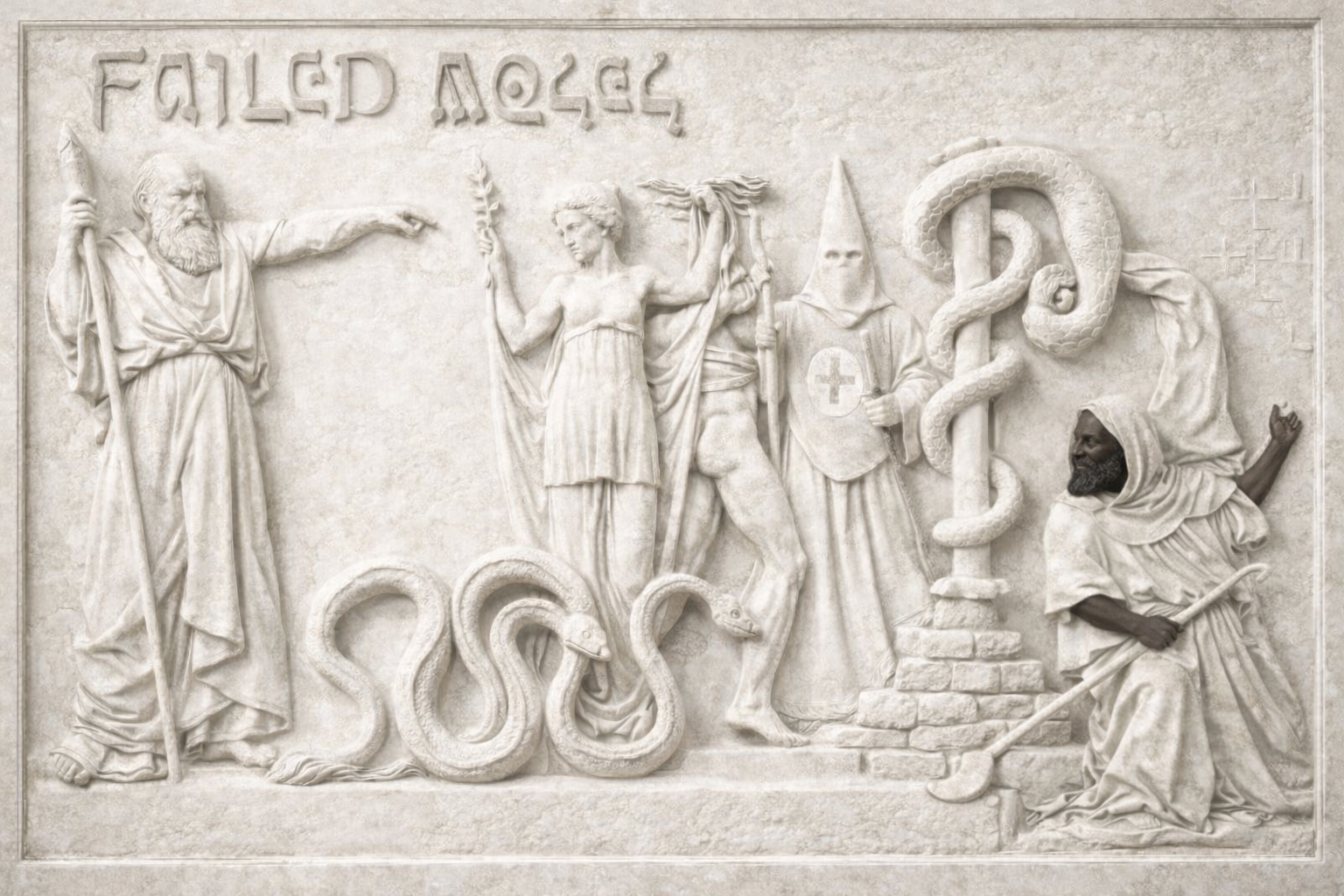
FAILED MOSES: CONJURE, THE CARROLLS AND MOSES, 1721-1865

Chapter 6: Death of Pharoahs First Born Son
In Exodus 4:22-23 the Lord commands Moses to tell Pharoah that if he does not let the Israelites leave Egypt to worship him in peace, he shall kill the Pharaoh’s first born son.
The Pharoah does not free God’s people. And the Pharaoh outlives his first born son.
At the turn of the century when the international slave trade was outlawed and Thomas Jefferson made a large portion of land from Napoleon’s France the United States, a Civil War seemed eminent.
Many first born sons would die in the American Civil War. But before this plague reached Maryland's shores Charles Carroll of Homewood was the fourth generation of slave-owning Carroll men, and more than past generations, he was known in public record for his drunkenness, womanizing, violence and early death.
The American Colonization Society was pharaohs attempt to let Moses’ people go. But most black Americans refused to colonize Africa.
For the slave owners of Maryland, and the abolitionists who sought to compromise with them, the beliefs of the enslaved people did not matter. “In December 1816 at Washington’s Davis Hotel, Francis Scott Key joined Senator Henry Clay, Senator Daniel Webster, Congressman John Randolph, General Andrew Jackson, and President-elect James Monroe at the founding meeting of the American Colonization Society. Rober Finley, a Presbytarian minister from New Jersey and director of Princeton Theological Seminary, called the first meeting and acted as its leading light. Finley and other Northern whites warmly embraced colonization as the best means of encouraging Southerners to end slavery. Clay agreed to chair the distinguished group.”
The founding fathers had replaced the pyramids of Giza with pyramidal mortgage schemes on enslaved Africans, the lives of enslaved people could be leveraged and borrowed against. The way the enslaved people were just assets on a page to be conveniently bundled into larger assets would prophecy the predatory lending schemes of the early 21st century that sought to exploit segregation and black poverty resultant from slavery. The end of the international slave trade, celebrated by hopeful black people as the first Emancipation Day, only limited the supply and further enriched the existing slave owning caste. The enslaved people they owned just became worth more money, and each child they brought into this world a more valuable asset. Maryland slave owners would be especially benefited by this development because their proximity to free states made the black men they enslaved, and the free black men they kidnapped, worth more money.

Chapter 5: Declarations of Dependence
Carrollton may have returned much what his father stole of D.C. to his cousins, and reportedly manumitted many slaves, specifically those rumored to be related to him. But Carrollton did not free the majority of the people he enslaved. And even those he did liberate, he agreed to do so only after he had taken their prime years for free.
Others sued in court for their freedom. Some won, most did not. And Carrollton made some promise to not sue. The way CCC and his fellow slave owning Jesuits avoided the law suits anticipated the domestic slave trade. This chapter is about the enslaved people who did not wait for the courts or permission, and took freedom for themselves.
Manumission (freedom) certificates and slave passes were the closest things that black bodies had to declarations of independence, yet these documents were only as credible as the white men who signed them. Slave ads were the inverse of manumission certificates or declarations of independence. Though they were created to terrorize and make property of humans fleeing for their lives and freedom, they could also be interpreted as declarations of dependence. Running away (in action) symbolized enslaved people’s rejection of their dependence on their master, while slave runaway ads demonstrated the master’s economic (at minimum) dependence on the return of the slave to the plantation. It is important that our founders declared independence from the English crown, seeing themselves as slaves to the King, while simultaneously declaring their dependence on enslaved labor in public documents. And one has to wonder how much Thomas Jefferson’s life among the people he enslaved influenced the tone of the document. Did Thomas Jefferson usurp the struggle of the black people he enslaved? Was he attempting to write from their point of view? Is this why he was so concerned about a black insurrection?
The men who ran away from Jefferson and Carrollton did not see them as liberators, but instead embodied liberation for themselves.

Chapter 4: ODB
Charles Carroll Annapolis only claimed his white bastard son, the last chapter was about the black ones, in order to steal the land that is now Washington DC from his nephew, whom he likely killed. The bastard child became Charles Carroll of Carrollton, the wealthiest, longest living and only Catholic, signer of the Declaration of Independence.

Chapter 3: 12 Black Madonnas
In the popular lexicon, Black Madonnas are “revered statues or paintings of the Virgin Mary and Infant Jesus with dark skin, found in Catholic and Orthodox traditions, notably the Black Madonna of Czestochowa in Poland. These icons, often dating from the 12th–15th centuries, are associated with miracles, fertility, and protection, with skin tones often attributed to candle smoke, aging materials, or symbolic representation.” In other words Black Madonnas are viewed as an exception; depictions of Jesus’ mother as a black woman in European countries, as opposed to the white Virgin Mary of the status quo. Mary was not European, nor was her son. Even the term “Middle Eastern” seems evasive of humanity’s subsuharan Africa origins. It must have been jarring for enslaved women to hear the stories of the women in the Bible. Venerated for qualities they saw in themselves, breastfeeding, nuturing, preparing food, bathing children that were not theirs, with no reward. Watching their children sold away in slavery, often by their white fathers. Sometimes at live auctions. The Black Madonna to these women is not some abstract painting or accidental smoke residue, it is embodied.

Chapter 2: Lil’Anthonys Part II
Between 1986 and 1990, archaeologists excavating the Annapolis Carroll House uncovered physical evidence of enslaved African religious practice—crystals, shells, and ritual objects—hidden beneath the foundations of one of the most powerful slaveholding families in colonial America.

Chapter 2: Lil’ Anthonys Part I
What Thomas Jefferson and Benjamin Franklin don’t acknowledge is that the Biblibal Moses was African. Not the Greco-Roman-Anglo fiction depicted in Jefferson and Franklin’s American mythology.
Europeans, specifically the Portuguese, initiated the Atlantic slave trade out of jealousy for a black Malian king named Moses. Europeans wanted Mansa Musa’s wealth in gold and slaves.
Before the Portuguese brought Catholicism to the Kongo, the African people with whom the Atlantic slave trade began, already knew of an incarnation of Moses. In the 14th-century, before a three-hundred-year global freeze, an Arabic king named Mansa Musa (‘Priest King Moses’ in Arabic) dominated Western Africa, the same region where European slavery began.

Chapter 1: Pharaoh v Moses
Harriet Tubman was not alone. There were many Black Moseses before her, enslaved people aspiring to free their people from the pharaoh.

PREFACE: U CAN’T C ME
The same way five generations of men named Charles Carroll used their shared name to consolidate inherited power, Tupac turned the name Clinton inside out and made it a weapon pointed back at the institution.

Failed Moses 3/14
Launching 3/14
This book traces a single unbroken thread: the conjure tradition that enslaved Africans used to survive, resist, and outlast the most powerful slaveholding dynasty in American history